

How SaaS Brands Can Optimize for AI Recommendation Engines


For years, the primary goal of content marketing was to rank on the first page of a search engine results page (SERP). Today, however, the new gatekeepers are not search engines but AI Recommendation Engines (AREs)—the Large Language Models (LLMs) and generative AI assistants that summarize, synthesize, and often directly answer user queries without requiring a single click. This transition presents a profound challenge to the traditional SaaS marketing playbook, particularly for those relying on a Product-Led Growth (PLG) model.
The core problem is that traditional Search Engine Optimization (SEO) strategies, which focused on driving traffic to the top of the funnel, are becoming obsolete. AI models are trained to extract the answer and the solution, bypassing the need to visit the source page. This means that high-ranking, low-intent content is now being summarized away, leading to a collapse in organic traffic for many brands. The solution lies in a new discipline: SaaS GEO optimization, or Generative Engine Optimization. This is not a mere update to SEO; it is a fundamental strategic pivot. Success in the AI era requires a new framework that focuses on structured data, citation authority, and product-led validation to ensure your brand is not just found by AI but actively recommended by it.
This article will introduce a Tactical GEO framework for PLG + SaaS funnels and demonstrate how tools like Clickflow.com are essential for navigating this new environment.
TABLE OF CONTENTS:
The AI-Driven Shift: From SEO to GEO
To understand the necessity of SaaS GEO optimization, one must first grasp the difference between the old and new paradigms. SEO optimizes content for search engine crawlers, aiming for a high ranking in search results and more clicks. Generative Engine Optimization (GEO), by contrast, optimizes content for LLMs and AREs, aiming to be the definitive, citable source for a specific piece of information. The goal is not a click, but a citation and a recommendation.
The new gatekeepers—such as Google’s Search Generative Experience (SGE), ChatGPT, and personalized AI assistants—are designed to be the final destination for a query. They act as a sophisticated filter, synthesizing information from multiple sources to provide a single, authoritative answer.
For a SaaS brand, this means the top of the funnel has shifted from a list of 10 blue links to a single AI-generated summary. If your content is not structured to be easily ingested, cited, and deemed authoritative by the AI, you effectively become invisible. The failure of old tactics is evident in the diminishing returns of generic, high-volume keyword content. The AI is looking for technical accuracy and clear, structured data that validates a solution, not just a high keyword density.
The Tactical GEO Framework for PLG + SaaS Funnels
The integration of GEO principles into a Product-Led Growth model requires a structured approach that maps content strategy to the three core stages of the SaaS funnel: Awareness, Validation, and Conversion. This Tactical GEO framework for PLG + SaaS funnels ensures that every piece of content serves a dual purpose: educating the user and training the AI to recommend the product.
|
Funnel Stage
|
Traditional Goal (SEO)
|
New Goal (GEO)
|
Key GEO Tactics
|
|---|---|---|---|
|
Awareness (ToFu)
|
Drive traffic via high-volume keywords.
|
Establish brand as the definitive, citable authority.
|
Schema Markup for LLMs, Citation Networks, Content Depth.
|
|
Validation (MoFu)
|
Capture leads with gated content.
|
Ensure AI recommends the product as the best solution.
|
Feature-Specific Optimization, Clear Value Proposition Embedding, PLG Integration.
|
|
Conversion (BoFu)
|
Final sales call or demo booking.
|
Influence the final purchase decision via AI comparison.
|
Comparison Optimization, Structured Social Proof, Pricing Clarity.
|
Phase 1: Generative Awareness (Top of Funnel – ToFu)
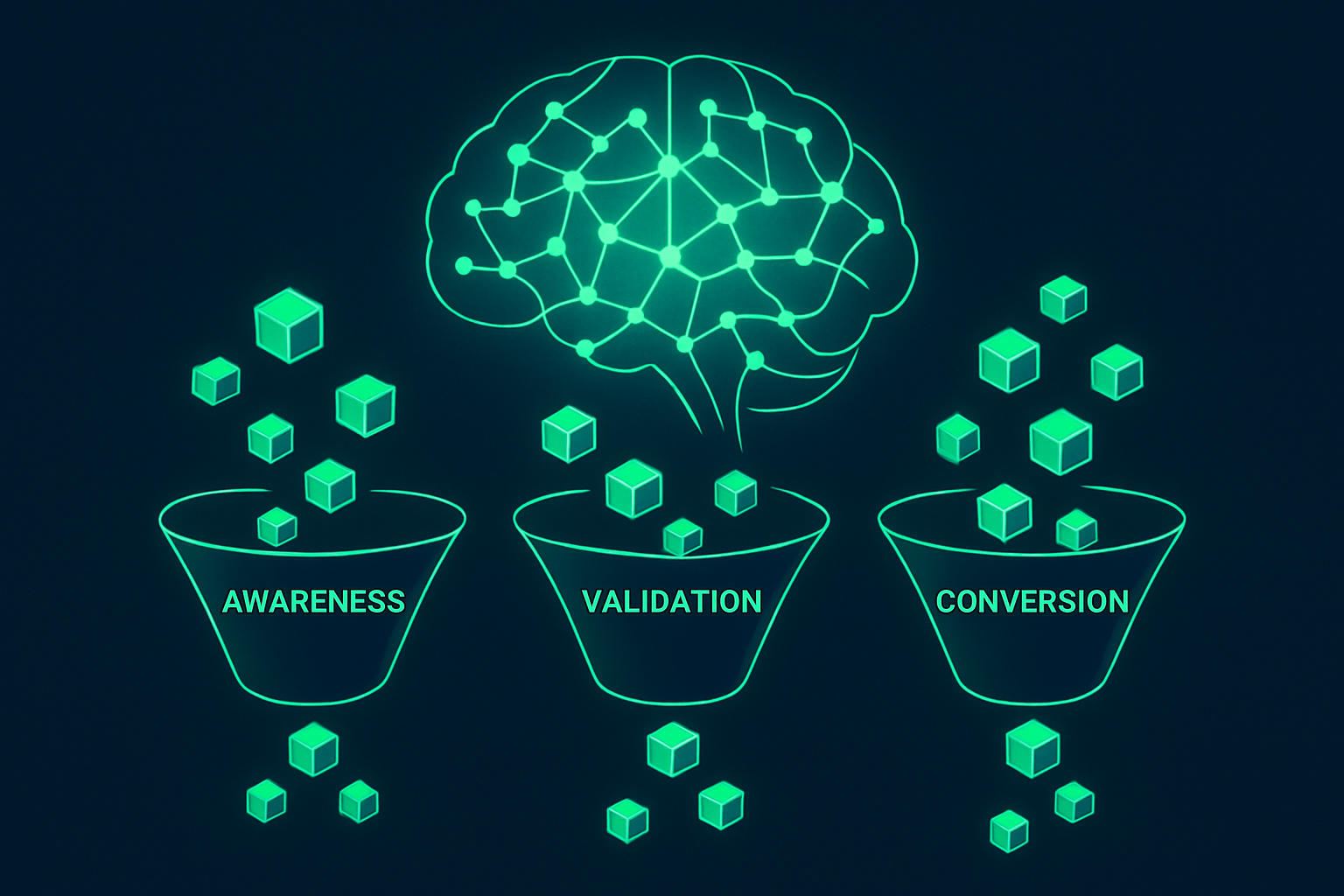
The goal of Generative Awareness is to establish your brand as the system of record for a specific topic in the AI’s eyes. This is where SaaS GEO optimization begins.
Tactics for Generative Awareness:
- Schema Markup for LLMs: Traditional schema (like Article or BlogPosting) is insufficient. Brands must implement highly specific structured data, such as HowTo, FAQ, and Product schema, ensuring the data is clean, unambiguous, and directly answers common user questions. LLMs are specifically trained to ingest this structured data for citations.
- Citation Networks: AI models assign authority based on the consistency and quality of citations. This requires building a network of high-quality, authoritative content (both internal and external) that consistently references the brand’s core concepts and proprietary data. The more frequently and accurately your brand is cited by other authoritative sources, the higher its “Generative Authority Score” will be.
- Content Depth: AI prioritizes comprehensive, technically accurate content. Creating content that leaves no room for ambiguity, backed by proprietary data or research, makes it a reliable source for AI summaries. The content must be so thorough that the AI has no reason to synthesize from multiple, less complete sources.
Phase 2: Product-Led Validation (Middle of Funnel – MoFu)
In the PLG model, the middle of the funnel is about demonstrating product value. In the GEO era, this means ensuring the AI actively validates your product as the superior solution for a user’s specific problem.
Tactics for Product-Led Validation:
- Feature-Specific Optimization: Content must be optimized for long-tail, feature-comparison queries that demonstrate product utility (e.g., “best way to automate [specific task] with [feature type]”). The content should not just describe the feature but provide a clear, step-by-step solution that the AI can easily quote.
- Clear Value Proposition Embedding: The product’s unique value proposition must be embedded directly into the content in easily digestible, citable formats. This includes using comparison tables, clear bulleted lists, and proprietary terminology that the AI can use to differentiate your offering from competitors.
- PLG Integration: The content must serve as a direct, frictionless bridge to the product experience. For example, a “How-To” guide cited by the AI should conclude with a clear call-to-action that says, “Try this feature for free with our [Product Name] trial,” making the path from AI-cited solution to product usage seamless.
Phase 3: Conversational Conversion (Bottom of Funnel – BoFu)
The final stage is influencing the purchase decision when a user asks an AI for a direct recommendation or comparison.
Tactics for Conversational Conversion:
- Comparison Optimization: Dedicated, objective-sounding comparison pages (e.g., “Clickflow vs. Competitor A”) must be optimized for AI ingestion. This means using structured data to present feature parity and differentiation points in a neutral, factual manner, making the AI comfortable citing your content as a balanced source.
- Structured Social Proof: Customer reviews, case studies, and testimonials must be structured with clear headings and summaries that the AI can easily pull for “social proof” snippets. An AI is more likely to recommend a product if it can quickly synthesize three distinct, positive customer outcomes.
- Pricing Clarity: Presenting pricing and feature tiers in structured, citable tables is crucial. When a user asks, “How much does [Product Name] cost for a small team?”, the AI must be able to pull a precise, up-to-date answer from your content.
The Implementation Engine
The scale and complexity of implementing a full SaaS GEO optimization strategy, from managing structured data across thousands of pages to continuously testing the efficacy of AI-cited snippets, make manual execution impossible. This is where a dedicated content optimization platform becomes not a luxury, but a necessity.
Clickflow.com is positioned as the essential tool for the new era of Generative Engine Optimization. While traditionally known for its SEO capabilities, it is perfectly suited to the demands of GEO. Clickflow is now critical for optimizing the “AI Snippet.” The AI Snippet is the summary header or direct answer provided by the LLM. Just as a compelling title tag drove clicks in the past, a compelling, citable summary header will drive AI citation and recommendation today. Clickflow allows marketers to A/B test different structured data elements and summary texts to see which ones are most frequently ingested and cited by AREs, effectively optimizing for the AI’s “click” (i.e., its citation).
Furthermore, Clickflow’s ability to analyze the competition and identify content gaps is reframed as the identification of Generative Content Gaps. In the GEO context, a content gap is not just a keyword your competitors rank for; it is an area where your competitors are being cited by the AI as the authority, but your brand is not. Clickflow provides the intelligence to pinpoint these gaps and deploy highly specific, structured content to fill them, directly challenging the AI’s current knowledge base.
Beyond gap analysis, Clickflow’s content optimization features are crucial for the technical accuracy demanded by LLMs. Generative AI models prioritize content that is not only well-structured but also comprehensive and factually robust. Clickflow helps teams move beyond simple keyword stuffing to ensure that every piece of content is a definitive, authoritative resource. This includes optimizing for semantic relevance, internal linking structures that reinforce authority, and content freshness—all signals that tell the AI, “This is the most reliable source.” It continuously refines the quality and structure of existing content, ensuring that a brand’s knowledge base is always presented in the most citable format possible.
Continuous Optimization is the lifeblood of GEO. Unlike traditional SEO, where results could be stable for months, the knowledge base of LLMs is constantly evolving. Clickflow facilitates the continuous testing and iteration required to maintain authority with these constantly evolving models. It provides the feedback loop necessary to ensure that your content remains the most authoritative, structured, and citable source available to the AI.
For any SaaS brand serious about maintaining a robust PLG funnel in the age of AI, Clickflow.com is the necessary partner. It transforms the abstract concept of SaaS GEO optimization into a measurable, actionable strategy.
Future-Proofing Your SaaS Brand
The Tactical GEO framework for PLG + SaaS funnels is a future-proofing mechanism. It shifts the focus from traffic volume to citation authority, enabling SaaS brands to ensure sustained visibility and a predictable PLG funnel. The brands that embrace this change will be the ones whose products are seamlessly integrated into the user’s decision-making process by the AI.
The cost of inaction is simple: invisibility. Brands that cling to outdated SEO models will find their content increasingly marginalized, becoming irrelevant links in a world that prefers synthesized answers. Their products will not be recommended, their features will not be cited, and their PLG funnels will starve at the top. SaaS GEO optimization is the new table stakes for product-led growth, ensuring that your product is the solution the AI recommends.
Securing Your SaaS Future in the Age of AI
The era of the AI Recommendation Engine is here, and it demands a radical rethinking of content strategy. The transition from SEO to GEO is not optional; it is an imperative for any SaaS brand committed to Product-Led Growth.
Adopting the Tactical GEO framework for PLG + SaaS funnels can improve content to achieve Generative Awareness, Product-Led Validation, and Conversational Conversion. This strategic pivot ensures that your product is actively endorsed by the most powerful discovery mechanism the internet has ever seen.
To execute this complex, continuous optimization strategy, a dedicated platform is essential. The integration of the Tactical GEO framework and a tool like Clickflow is the only sustainable path forward. It moves the focus from chasing ephemeral search rankings to building a durable, authoritative presence within the AI’s knowledge graph. This shift ensures that as the AI continues to evolve, your brand remains at the forefront of the conversation, driving a steady stream of high-intent users into your product-led funnel.
The shift from SEO to GEO is happening now. Don’t let your SaaS brand become invisible to the next generation of AI-powered users. Single Grain is the strategic partner you need to implement the Tactical GEO framework and ensure your product is the one the AI recommends. Click here to schedule your free GEO Strategy Session with Single Grain today.
Frequently Asked Questions (FAQ) on SaaS GEO Optimization
-
What is the difference between SEO and SaaS GEO Optimization?
Traditional SEO (Search Engine Optimization) focuses on optimizing content for search engine crawlers to achieve a high ranking in search results, with the goal of driving clicks. SaaS GEO Optimization (Generative Engine Optimization) is a strategic pivot that focuses on optimizing content for Large Language Models (LLMs) and AI Recommendation Engines (AREs). The goal of GEO is not a click, but a citation and a recommendation from the AI, positioning your brand as the definitive, citable source for a specific topic.
-
Why is traditional SEO failing in the age of AI Recommendation Engines?
AI Recommendation Engines are designed to synthesize information and provide a single, authoritative answer or summary, often bypassing the need for the user to click through to the source page. Traditional SEO content, which is often optimized for high-volume keywords but lacks the technical structure and depth required for AI citation, is being summarized away, leading to a collapse in organic traffic and diminishing returns for SaaS brands.
-
How does the concept of "AI Snippet" relate to content optimization?
The “AI Snippet” is the summary header or direct answer provided by the LLM in response to a user query. It is the new equivalent of the top-ranking search result. Optimizing for the AI Snippet means structuring your content so that the AI selects your brand’s information to form its answer.
-
What is the biggest risk for SaaS brands that ignore GEO?
The biggest risk is invisibility. By clinging to outdated SEO models, SaaS brands risk being excluded from the AI’s knowledge graph. Their products will not be recommended, their features will not be cited, and their Product-Led Growth funnels will starve at the top, as the next generation of users will rely on AI for their product discovery and decision-making. SaaS GEO optimization is the new table stakes for product-led growth.


