

How to Build LinkedIn ABM Attribution in HubSpot with AI


Your CMO just asked the question that keeps marketing leaders up at night: “Which LinkedIn campaigns are actually driving deals?” Traditional attribution models point to last-touch activities, leaving your ABM investments in a gray zone of uncertainty. Meanwhile, your sales team insists their LinkedIn outreach closed the deal, while your paid ads team claims credit for the same opportunity.
The solution isn’t about choosing sides; it’s about building an AI-powered attribution system that connects every LinkedIn touchpoint to actual pipeline movement within HubSpot. When LinkedIn is 277% more effective for lead generation than other social platforms, you can’t afford attribution blindness.
Key Takeaways
- AI-powered attribution solves LinkedIn ABM measurement gaps by analyzing behavioral patterns to understand actual influence rather than relying on arbitrary first-touch or last-touch models that miss the warming activities happening before prospects enter your funnel.
- Integrate LinkedIn Campaign Manager, Sales Navigator, and organic LinkedIn data with HubSpot to capture both explicit actions (ad clicks, profile views) and implicit signals (content engagement patterns) for comprehensive attribution tracking.
- Configure custom attribution models that weight LinkedIn activities based on actual pipeline influence rather than using default models, especially weighting activities that typically occur 30-45 days before conversion in your specific sales process.
- Track three critical ROI metrics for budget justification: direct revenue attribution (LinkedIn as primary influence), influenced revenue (LinkedIn as supporting role), and pipeline acceleration value (monetary value of shortened sales cycles).
- Scale confidently using proven performance patterns by leveraging AI attribution data to identify which specific LinkedIn activities generate the highest-quality pipeline, enabling data-driven budget reallocation toward tactics with demonstrated ROI increases.
TABLE OF CONTENTS:
Why LinkedIn Is the Cornerstone Channel for HubSpot ABM
LinkedIn’s lead generation advantage isn’t just about volume; it’s about quality and intent. 67% of B2B buyers make their buying decisions before contacting sales, creating multiple attribution touchpoints that traditional analytics miss.
Your HubSpot instance already captures email opens, website visits, and form submissions. But without LinkedIn integration, you’re missing the warming activities that happen before prospects enter your funnel. Consider this scenario: a CFO sees your LinkedIn ad, visits your pricing page anonymously, returns through organic search a week later, and then finally converts through an email campaign. Which channel gets credit?
“The best ABM programs don’t just track conversions. They map influence patterns across every touchpoint, especially on LinkedIn where relationships form before prospects raise their hands.”
This is where AI-powered attribution becomes essential. Instead of arbitrary assignment rules, machine learning algorithms analyze behavioral patterns to understand actual influence. They recognize that the LinkedIn ad didn’t just “assist”—it initiated a consideration journey that your email campaign completed.
The AI-Powered Attribution Framework That Changes Everything
Traditional attribution models break down in complex B2B sales cycles. First-touch gives all credit to discovery activities. Last-touch strategies overlook the nurturing that brings prospects to conversion readiness. Linear attribution assumes all touchpoints contribute equally, which rarely happens.
AI attribution examines the actual impact patterns in your data. It identifies which LinkedIn activities correlate with deal progression, account engagement depth, and sales velocity. More importantly, it updates these models continuously as your campaigns generate new behavioral data.
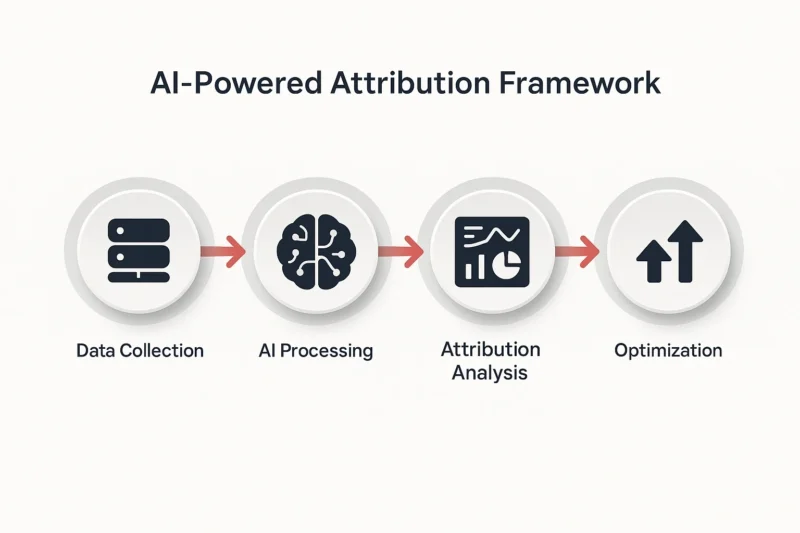
The framework operates on three attribution layers: influence mapping, velocity analysis, and account engagement scoring. Influence mapping tracks how LinkedIn activities impact the movement of prospects through your HubSpot pipeline stages. Velocity analysis measures which touchpoints accelerate deal progression. Account engagement scoring combines individual and organizational signals to predict the likelihood of conversion.
Building Your HubSpot-LinkedIn ABM Foundation
Implementation starts with data architecture. Your HubSpot-LinkedIn integration needs to capture both explicit actions (ad clicks, profile views) and implicit signals (content engagement patterns, network connections). This requires connecting LinkedIn Campaign Manager, Sales Navigator, and your organic LinkedIn presence to HubSpot’s attribution tracking.
| Integration Component | Data Captured | Attribution Value |
|---|---|---|
| LinkedIn Campaign Manager | Ad impressions, clicks, conversions | Demand generation influence |
| Sales Navigator | Profile views, connection requests, InMail | Direct outreach attribution |
| Organic LinkedIn | Content engagement, company follows | Brand awareness impact |
| HubSpot Forms | Conversion sources, UTM parameters | Direct conversion tracking |
A large enterprise company faced challenges in increasing LinkedIn leads. They used Karrot.ai to personalize LinkedIn ads. The results were transformative: a 64% improvement in MQL-to-opportunity conversions.
Implementing Multi-Touch Attribution for Pipeline Clarity
HubSpot’s native attribution reports provide a foundation, but AI enhancement transforms basic tracking into predictive intelligence. The key is to configure custom attribution models that accurately reflect your specific sales process and the complexity of your buyer journey.
Start with HubSpot’s attribution settings, but don’t stop at the default models. Create custom models that weight LinkedIn activities based on their actual influence in your pipeline. For example, if LinkedIn ad engagement typically occurs 30-45 days before conversion, your model should increase attribution weight for activities in that timeframe.
Your attribution model should track three critical metrics: pipeline influence (how LinkedIn activities affect deal creation), progression velocity (how touchpoints accelerate movement between stages), and close rate correlation (which LinkedIn activities appear in won deals versus lost opportunities).
Scaling and Optimizing Your AI-Driven ABM Engine
Once your foundation is established, optimization becomes an ongoing AI-assisted process. Your attribution data reveals which LinkedIn activities generate the highest-quality pipeline, enabling you to reallocate your budget toward proven tactics.

Consider the broader context: 93% of marketers report their account-based marketing efforts are very or extremely successful. Your AI-powered attribution system ensures you join that successful majority by proving which specific activities drive results.
Measuring and Proving ROI with Advanced Attribution Models
The ultimate test of your HubSpot LinkedIn ABM system is an ROI demonstration. AI attribution provides the data needed to calculate true return on investment, not just surface-level metrics like cost per click or impression volume.
Advanced attribution models track dollar influence, not just conversion assistance. They calculate the revenue value of each LinkedIn touchpoint based on its correlation with closed deals. This enables precise ROI calculations that account for long sales cycles and multiple influencing factors.
Your AI attribution dashboard should display three key ROI metrics: direct revenue attribution (deals where LinkedIn was the primary influencer), influenced revenue (deals where LinkedIn played a supporting role), and pipeline acceleration value (the monetary value of shortened sales cycles resulting from LinkedIn engagement).
For marketing leaders who need to justify and expand LinkedIn ABM investments, these metrics provide the concrete evidence required for budget conversations. The integration of AI-powered ABM with advanced attribution creates a feedback loop that continuously improves performance. Your system learns which activities drive results, automatically optimizes targeting and messaging, and provides the data needed for confident scaling decisions.
Your Next Steps to AI Attribution Success
Building HubSpot LinkedIn ABM with AI pipeline attribution isn’t a one-time setup; it’s an optimization process where results improve over time. Start with data integration, progress to custom attribution models, and evolve toward predictive optimization.
The key is starting with clear measurement objectives. Define what success looks like for your organization: pipeline volume, deal velocity, account engagement depth, or revenue attribution accuracy. Your AI system will optimize toward these metrics, so choose wisely.
Begin with HubSpot’s native LinkedIn integration to establish data flow. Configure custom attribution models that accurately reflect the complexity of your sales process. Implement AI-powered lead scoring to prioritize high-value prospects. Then scale based on proven performance patterns.
If you’re ready to eliminate attribution guesswork and build confidence in your LinkedIn ABM investments, consider getting expert guidance on implementation. The right approach can transform your marketing measurement from reactive reporting to predictive optimization.
Ready to see how AI-powered attribution could transform your LinkedIn ABM results? Get a Free Audit to discover your specific opportunities for attribution improvement and pipeline acceleration.
Frequently Asked Questions
-
Why is LinkedIn more valuable for ABM than other social channels?
LinkedIn stands out because of its professional audience, precise targeting, and influence on early-stage buying behavior. Unlike Facebook or Twitter, LinkedIn provides direct visibility into decision-makers’ activities, making it the most reliable channel for influencing B2B deals before prospects formally engage with sales.
-
How does HubSpot benefit from LinkedIn integration?
HubSpot already captures email, web, and form data, but without LinkedIn integration, critical pre-funnel interactions go unseen. After syncing LinkedIn Campaign Manager, Sales Navigator, and organic LinkedIn data with HubSpot, marketers gain a full picture of influence across the buyer’s journey.
-
What problems do traditional attribution models create?
Traditional attribution gives disproportionate credit to one or two touchpoints—like first-touch or last-touch—ignoring the nurturing and influence that occur in between. This skews ROI reporting and leads to poor budget allocation. AI attribution solves this by analyzing behavioral patterns across every touchpoint.
-
What does AI-powered attribution actually do differently?
AI attribution doesn’t just count clicks; it maps how LinkedIn activities correlate with pipeline creation, deal velocity, and account engagement depth. This continuously updates based on new data, ensuring your attribution model evolves with real buyer behavior rather than static rules.
-
How does AI attribution measure ROI from LinkedIn ABM?
AI-driven models calculate the dollar influence of LinkedIn activities by linking them to closed deals. Instead of just tracking clicks or impressions, it reveals:
-
Direct revenue attribution (where LinkedIn was the main driver)
-
Influenced revenue (where LinkedIn supported other channels)
-
Pipeline acceleration value (shortened sales cycles tied to LinkedIn engagement)
-
-
Is implementing LinkedIn + HubSpot integration complicated?
Not necessarily. It starts with connecting LinkedIn Campaign Manager, Sales Navigator, and organic analytics to HubSpot. From there, you can configure custom attribution models and enable AI-powered lead scoring. Many companies see meaningful results within weeks, especially when supported by an expert setup.
-
How does this impact sales teams directly?
Sales teams get richer context on account behavior—like knowing a CFO viewed a LinkedIn ad before responding to an email. This helps prioritize outreach, personalize engagement, and shorten sales cycles by aligning sales actions with verified buying signals.
-
What’s the risk of not adopting AI-powered attribution now?
Without it, you risk underreporting LinkedIn’s true impact, misallocating budget, and slowing down pipeline growth. Competitors who adopt advanced attribution gain clearer insights, enabling them to double down on high-performing tactics while others remain blind to influence patterns.