

Website USAbility vs SEO: Which Is More Important?


Whether you’re looking for the lowest price on a new laptop or searching for the best dentist in your area, a significant proportion of our online activity is determined by search engine results.
The big players in the search engine market, such as Google, have gained massive popularity among billions of users worldwide as a direct result of the high quality of their search results. These search engines gauge numerous metrics related to a website prior to assigning it a search engine rank. These metrics can be roughly categorized into two leagues: criteria that determine website usability and factors pertaining to a website’s SEO.
Different websites perceive the relative importance of these fields differently. For some, it is very important to follow the nitty-gritty of SEO tactics. For others, it is vital to have an impactful and easily usable website design.
This raises the age-old question: what is more important in attaining the much-coveted higher search engine ranking, usability or SEO? And will website usability eventually become more important than SEO?
To answer this question, let us first try to understand what each of these paradigms mean.
TABLE OF CONTENTS:
Understanding Website USAbility
Have a look at these two websites.
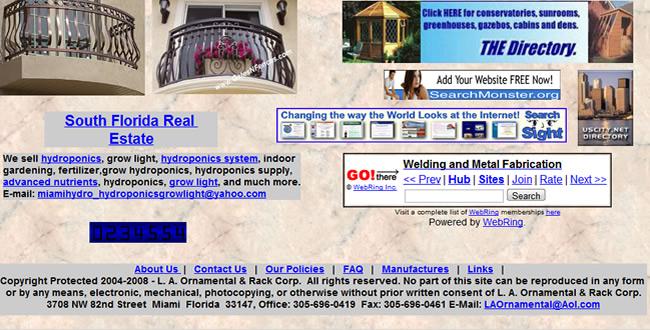
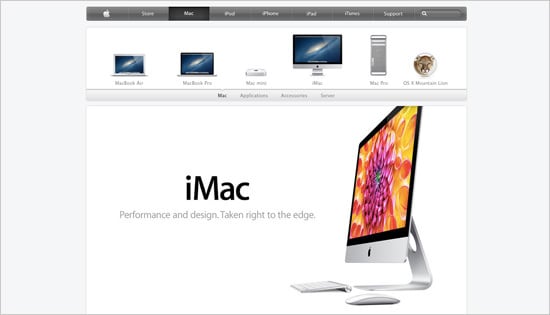
The difference is obvious. One site attracts you with its simple and clean design, while the other pushes you to close the tab immediately. The website on the right compels you to navigate it to see what they offer, but the one on the left leaves you confused and unsatisfied.
This key – what makes one website more appealing & engaging than another – is called usability. Share on XThe term “website usability” encompasses all the attributes of a website that make it user friendly. Coined in the 1980s in an article about usability engineering by John Whiteside of Digital Equipment Corporation and John Bennett of IBM, this term introduced to the world the concept of perceiving an online entity from the point-of-view of the user.
According to Prioritizing Web USAbility, the usability of a website is expressed through the ease with which a user is able to learn how to use the website and the level of satisfaction gained in this process. A website with good usability is easy to understand. It is able to meet the user’s needs effectively and efficiently. The different features included within such a website are fun to use and keep the users well-engaged on the platform.
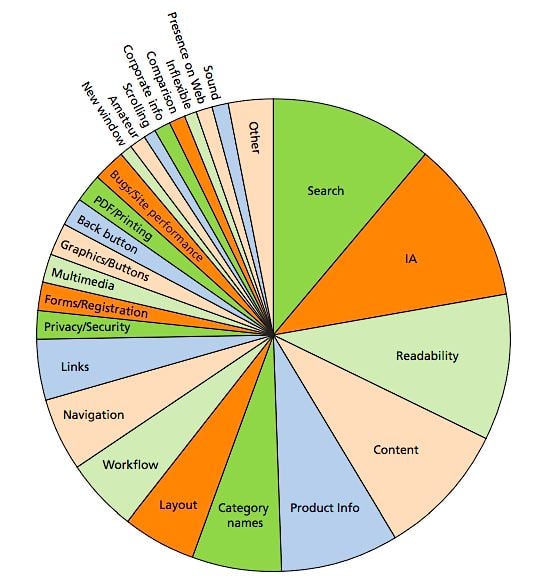
When a site does not meet these requirements and frustrates the user into giving up on the site, this is seen as “an estimate of the total misery of the experience.” Here are the problems that cause users the most trouble, known affectionately as The Scale of Misery:
Learn More: Effective SEO Techniques that Work in 2017
What Is SEO?
SEO stands for Search Engine Optimization and, as the name suggests, refers to all the processes required to optimize a website for search engines. In simple terms, by knowing how the search industry works, SEO experts can help generate more online traffic for your website by ranking your web page higher in the SERPs. SEO deals with channeling more unpaid, or “organic,” traffic towards your website. An organic search result is one that appears naturally on a search engine because of its relevance to the search query.
These two concepts – website usability and SEO – are closely related. A website with good usability and that is optimized for search engines will undoubtedly gain more online traffic. Even though the definition of “good” or “best” websites can be subjective, search engines evaluate certain criteria, as outlined by Moz, to decide whether that particular website is relevant to a user’s search query, such as:
- Easy to use, navigate, and understand
- Provide direct, actionable information relevant to the query
- Professionally designed and accessible to modern browsers
- Deliver high quality, legitimate, credible content
If a website has a confusing navigation structure and demands too much information from the user for registration, it doesn’t have good usability. And if a website ranks too low in a search engine, chances are it will not receive much organic traffic.
Both website usability and SEO are significant for boosting online traffic. Share on X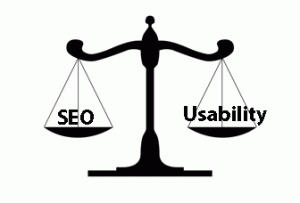
While traditionally these entities are viewed as opposites, an effective combination of both is crucial to a website’s success. A website with great SEO but bad usability might appear high on search engine rankings, but it will eventually witness more online visitors bouncing off the website. Similarly, a website with good usability won’t experience a huge influx of traffic if it’s not optimized for search engines.

Search Engine Rankings – Then and Now
Once upon a time, optimizing a website for search engines wasn’t a complex task. All you had to do was get hold of certain keywords that were relevant to the website and spread them profusely across the page’s content.
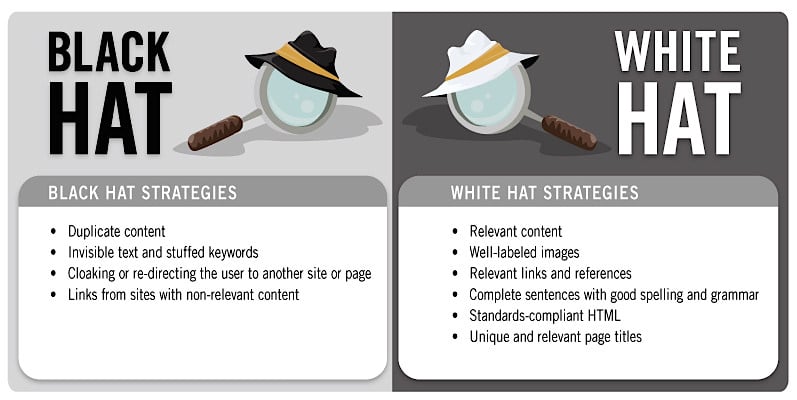
As more and more websites were built, this procedure became more aggressive in nature. The collective term used to describe such techniques is black hat SEO techniques. SEO experts started using unethical ways to violate search engine algorithms. They started resorting to web-spamming or spamdexing through excessive keyword stuffing, recycling old content (article spinning) to rank higher on the search engine results, and content automation, in which website content is automatically updated and/or created by software.
Learn More: How to Rank Using SEO Black Hat Tactics in a White Hat Way
The biggest problem with black hat SEO is that instead of showing content that is relevant to the user’s query, it presents a list of “spammy” websites and links. Such websites leave the user dissatisfied as they were designed only for ranking high in the SERPs and not for an actual person’s needs.
Google recognized how black hat SEO tactics were hampering a user’s online search experience and hence built better search algorithms which made the results more personalized and predictive.
Today, the search results shown by Google are not merely limited by the frequency of keywords. In fact, it takes into consideration roughly 200 factors while ranking a website. A few of the important ones are:
- Content length
- Webpage loading speed
- How recently and frequently the content is updated
- Quality of outbound and inbound links
- User-friendly layout
- Relevant content
- Well-structured site architecture
- Number of webpages
- Mobile optimization
- Site reputation through user reviews
- Social media sharing
- Embedded contextual links
What this reveals is that Google and other major search engines are increasingly focusing on a website’s relevancy and ease of use when giving it a high ranking. In other words, it is placing more importance on website usability than on outdated black hat SEO.
Emerging Trends in Google Searches
In the last two years, we’ve seen significant changes in the way that search engines show results. According to Google, 20% of all mobile-based searches are voice based – and that number is expected to grow to 50% by 2020.
The mobile optimization of websites has also been rapidly gaining priority over desktop optimization owing to the ease and mobility that comes with smartphones and tablets. Google is progressively ranking videos (especially YouTube videos) and video-based content higher as compared to plain text content.
It is estimated that by 2019, almost 85% of online traffic will be for videos in the U.S. alone. And the relevance of local Google searches is so high that 72% of people who made such a search visited the store within 5 miles.
These statistics clearly demonstrate the fact that users find Google search results extremely effective since they are completely in sync with their demands. A website that ranks higher in the SERPs is likely to be more helpful to the user’s query as compared to a low-ranking search result.
Websites that have a clean, clutter-free design on both desktop and mobile attract more visitors; too much text or information on the site is both confusing and off-putting for the user. Having intuitive interfaces, well-guided navigation, interactive modules, and a consistent feel throughout the site all enhance user experience.
Working to ensure that visitors feel comfortable and satisfied with your website design is what makes your website a quality search engine result. And the search engine biggies, like Google or Yahoo, focus on these criteria when assigning your website a higher search engine ranking.
This is the power of website usability.
Yet there are certain situations where website usability takes a back seat. In some cases, rigorous SEO is the bigger need of the hour, like websites in which the first impression is more important than site navigation and user experience. Sites with very few pages or standalone landing pages that just require the user to fill out a registration form fall under this category. Websites built purely for short-term promotional or advertising purpose generally concentrate more on tweaking SEO than ranking high on search engines.
Additionally, if the competition’s website relies heavily on SEO techniques, it makes good sense to shift the focus from usability to SEO on your own because if your competitor is ranking higher on SERPs, it will be attracting a large portion of the online traffic. In such a situation, having extremely good usability will not matter much, especially if your brand is in the budding stage.
While Google has a comprehensive list of website attributes included in its algorithm, it is still possible to tinker with a few of these to achieve short-term SEO goals. In other words, prioritizing SEO over website usability will fetch your website some benefits, but these will be short-term, and hence suitable for a very tiny proportion of websites.
Unless you're planning on a short lifespan for your site, you need to prioritize usability over SEO. Share on XLearn More: The Future of SEO: How AI and Machine Learning Will Impact Content
Long-Term Gains with Website USAbility
As mentioned earlier, Google and other search engines have completely revamped the way they rank websites. Gone are the days when high-density keywords alone could help you get to page one of the SERPs. Today, it’s all about the quality of user experience that your website provides to the incoming online traffic.
Let’s take a deeper look into how website usability entities define the quality and relevance of search listings.
CTR, Bounce Rate, and Time on Website
Before jumping into how these elements affect website usability, let’s quickly go over what these terms actually mean.
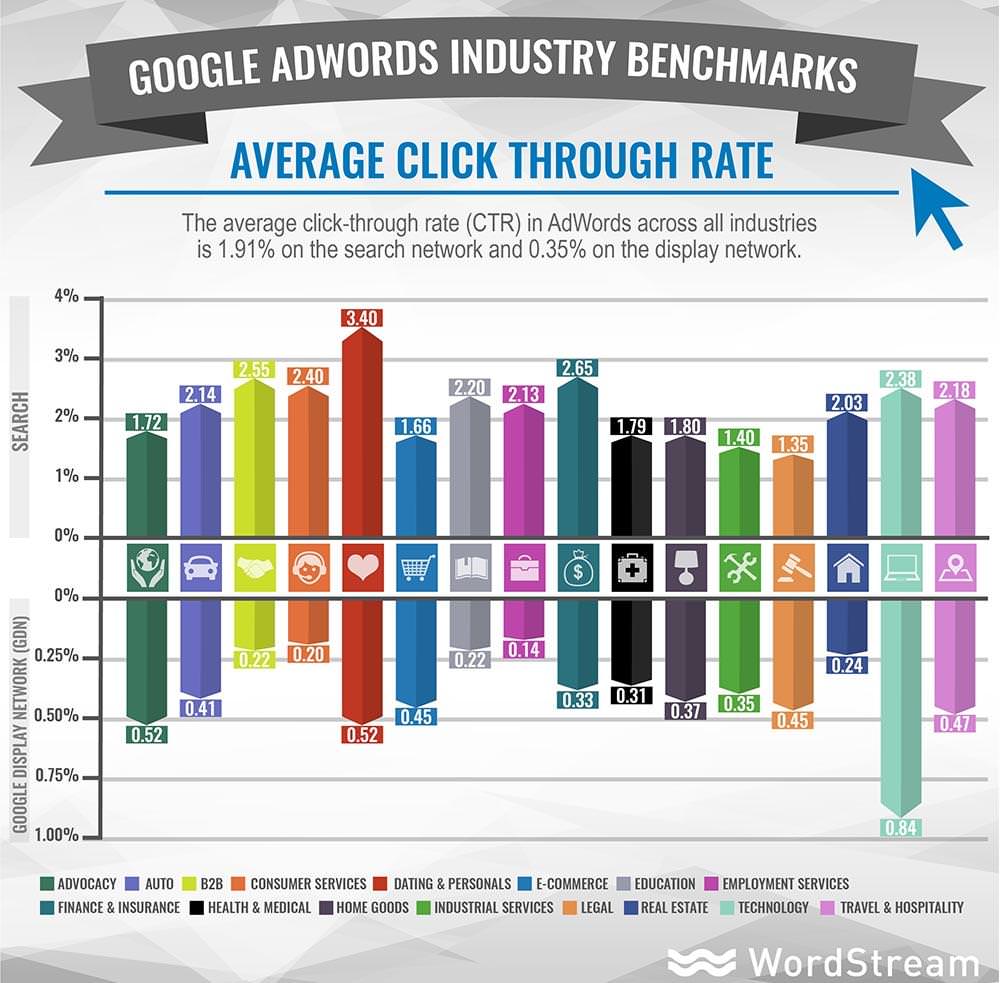
- Click-Through Rate (CTR). Mathematically, the CTR is calculated by dividing the number of clicks your website receives by the number of times that your site is displayed on a search list. The CTR for your website should be high since it reflects user engagement.
- Bounce Rate. This refers to the rate at which users leave your website without any further navigation or interaction with it. If this figure is high, it means that your website design has some serious flaws which are forcing users to “bounce off” your website shortly after landing.
- Time on Website. As the name suggests, time on website is a metric which reveals how much time a user spent on your site.
When viewed individually, these metrics don’t provide a clear picture of how well the website is performing. But when viewed together, these attributes reflect website usability.
Ideally, if your website design promotes user engagement and navigation, then your website has high usability. Whether the user finds your web content engaging or not can be gauged by bounce rate and time spent on your website.
A low bounce rate plus a lot of time spent on your website implies that your site is performing well in terms of usability.
Similarly, if the CTR is high, it means that users find your content relevant to their queries and hence prefer your website over others.
Another element that negatively affects website usability is pogo sticking, which is similar to bounce rate but is disliked by Google even more. This happens when the user goes to a website and within five seconds bounces off. It is a much clearer indicator of user dissatisfaction than high bounce rate.
Google keeps track of these metrics for each website and those that perform well on these criteria get higher ranking. Poor CTR, high bounce rate, and less time on a website reflect poorly on the site’s usability.
Thus, if you want your website to rank higher in SERP, work towards improving its usability.
Where SEO Conflicts with USAbility
Although in a majority of cases, SEO and website usability complement each other, certain SEO techniques could be counterproductive to usability elements. Let’s take a look at some scenarios.
Fat Footers and Obese Footers
By definition, a footer is found at the bottom of the website and includes corporate policies, legal terms and conditions, copyright, contact information, etc.
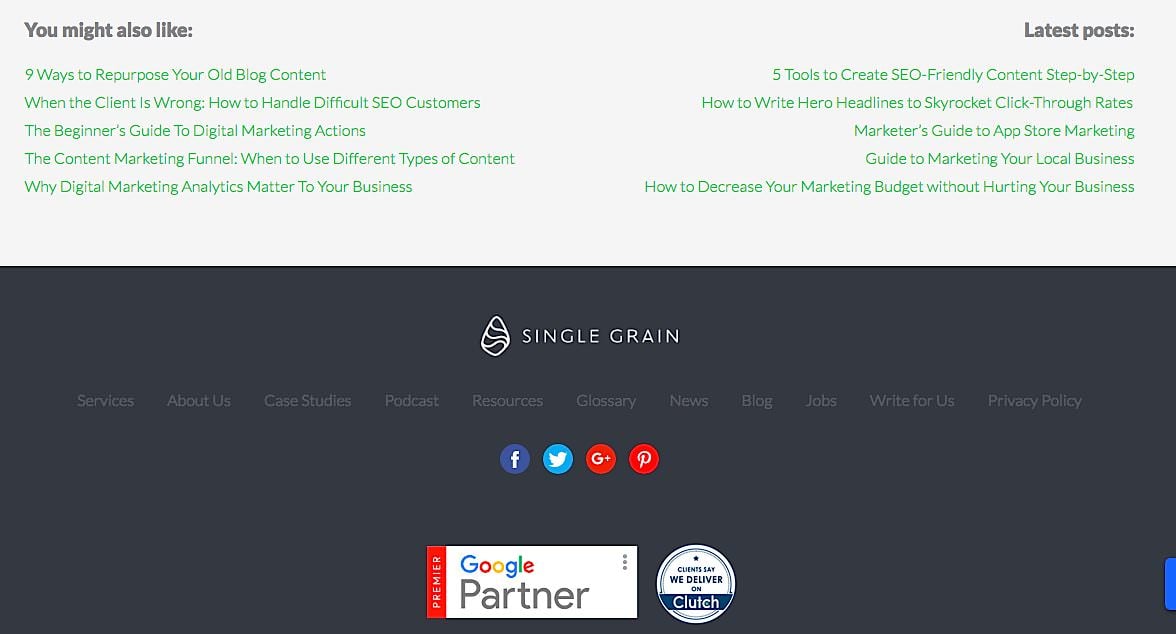
A fat footer is an extension of a traditional website footer that gives an additional idea about the company’s persona and how the company operates. It is a great way to provide some extra information about your company. Through fat footers, a company can provide a brief description of the business, announce latest discounts and offers, or even summarize its essence through clever use of graphics.
Here are a few examples:
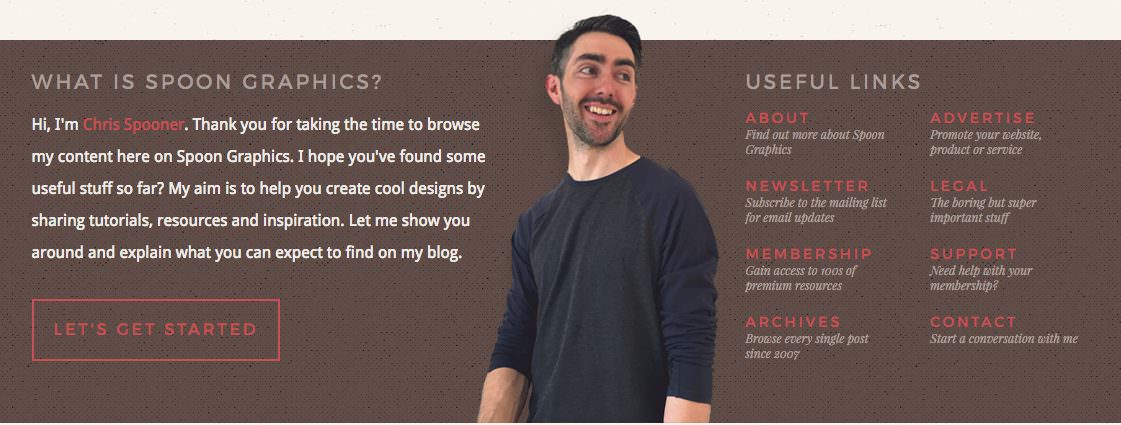
An obese footer is simply a further extension of a fat footer and enlists many more links, such as a brief introduction to the author, a search bar, most-read articles, most-visited links, extended list of policies, and so on.
This is where a website might stuff more keywords in an attempt to rank higher in search engine results. Have a look at few such obese footers:

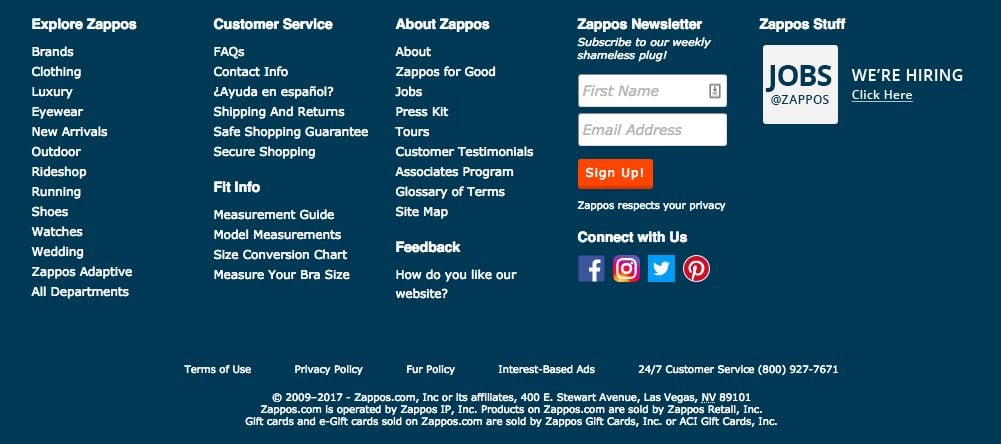
Fat footers and obese footers are considered good SEO techniques because of the presence of inbound and outbound links. Yet they may interrupt website usability by confusing the user with the plethora of links presented and making the website look “spammy.”
Keyword Stuffing
Repeating certain keywords hundreds of times is now considered a classic black hat SEO technique. Stuffing your website content with random keywords (like this hilarious example that Matt Cutts shares) shows that your website has nothing substantial to offer. Though it might give you a lift in the SERP initially, in the long run Google’s bots will find and blacklist your website.
Consider the following example:
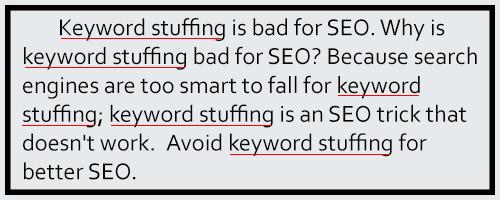
Even though the number of times the phrase “keyword stuffing” appears here is high, it presents poorly laid out content that is annoying to read and does not provide value to the user. This is completely opposed to the ethics of website usability which Google strictly adheres to which says: optimize websites for people, not for keywords.
Learn More: How to Write Content for People and Optimize It for Google
Improvements in Search Engine Algorithms
Search engines keep working to improve the accuracy of their algorithms. In a span of just one year, Google incorporated 890 changes in their algorithm to improve search accuracy. The Google Panda Update restricts the entry of dubious and poor-quality websites into top search results. The Google Hummingbird Update takes into account the contextual meaning of the query rather than operating on exact-keyword matching.
All these improvements mean that search engines have made accurate and user-friendly searches possible. With more mobile optimizations and voice searches being made, it is clear that in the race between website usability and SEO, enhanced website usability is winning.
Remember that even if SEO techniques are able to bring more traffic to your website, they don’t necessarily mean conversions. Successful conversions only occur when the SEO techniques focus on enhancing website usability.
Understanding the difference between website usability and SEO is crucial in designing a website which will yield long-term gains. It is important to use effective SEO techniques that are infused into website-usability design.



